Case studies from across Scotland
Last updated: 11 November 2026 · Reviewed by the Scottish Energy Efficiency team
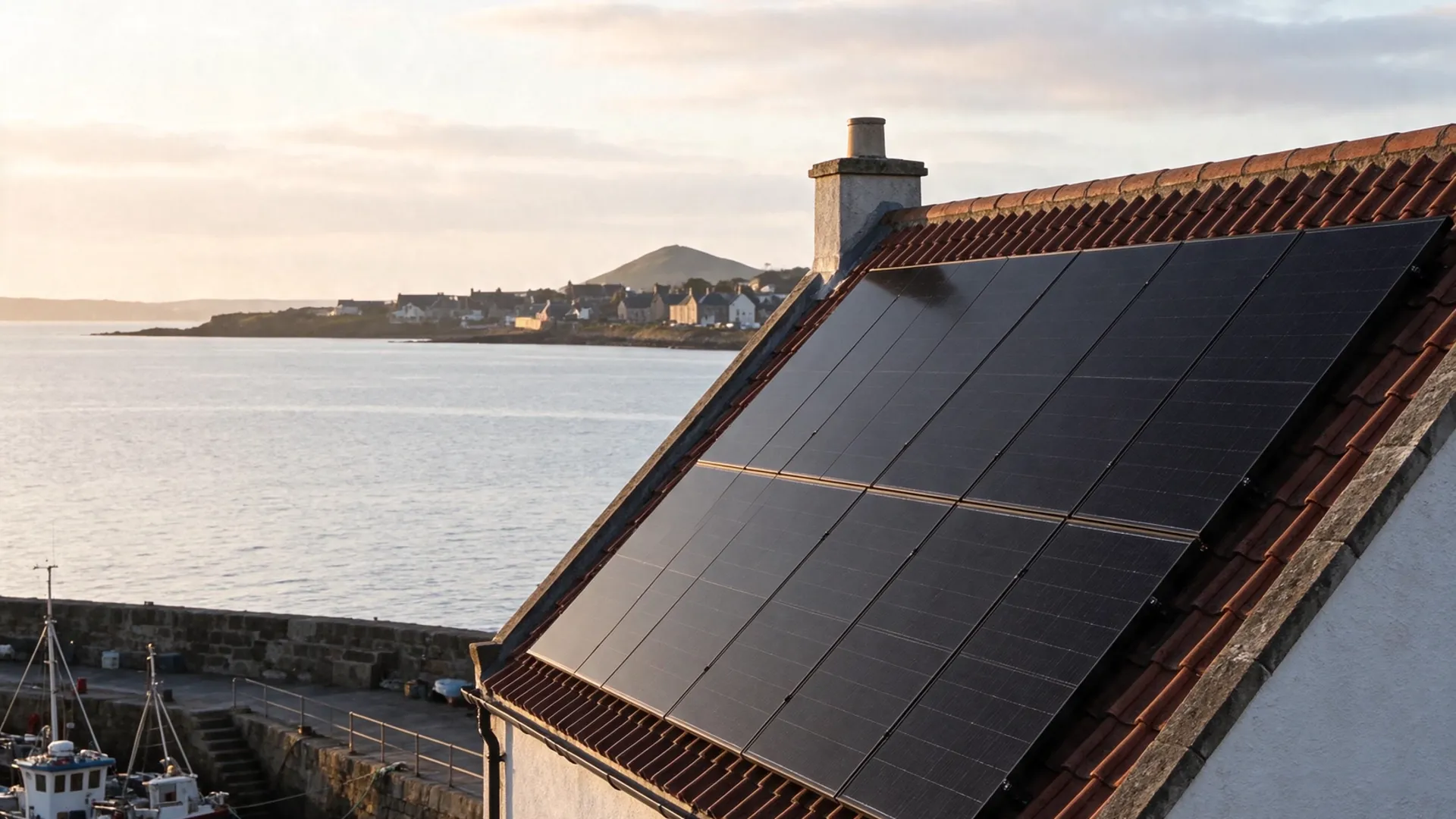
Quick answer: We have connected Scottish homeowners with installer partners for solar and battery installations across Fife, Perthshire and the Highlands. Every figure is illustrative, based on MCS MIS 3002 yield calculations. A no-obligation survey gives exact figures for your home. We install through MCS-certified partners.
What do real solar installs across Scotland look like?
Fife: 4kWp solar PV + 10kWh battery (Tesla Powerwall 3), 3,100 kWh/yr generation. Perthshire: 6kWp solar PV + Duracell Dura5, 4,500 kWh/yr, G99 DNO approval from SP Energy Networks. Highlands: 5kWp ground-mount solar + Pylontech US5000, 3,600 kWh/yr, SSEN G99 notification. All figures illustrative, based on MCS MIS 3002 yield calculations. A no-obligation survey gives exact figures for your home.
What does a typical solar installation look like?
A typical residential installation is a 3-6kWp solar array on a south, east or west-facing roof, paired with a 5-13.5kWh battery. The panels mount on the existing roof, the inverter is installed in a loft or utility area, and the battery is typically wall-mounted in a garage or utility room.
Every installation is tailored to the property. Roof orientation, pitch, shading and energy use pattern all affect system design. A no-obligation survey gives you exact figures for your home. All figures in our case studies are illustrative, based on MCS MIS 3002 yield calculations.
Can you install solar on a tenement flat?
Yes, with co-owner consent. Glasgow and Edinburgh have many sandstone tenements with shared roofs. Under the Tenements (Scotland) Act, roof works require co-owner consent. We advise on the consent process and assess roof access during the survey.
Tenement flats in conservation areas — such as Glasgow's West End or Edinburgh's New Town — may also need planning permission or listed building consent. We check all of this before quoting. The system size is typically smaller for tenement flats due to shared roof space.
What about ground-mount solar for rural properties?
Ground-mount solar arrays are an option for rural properties with land and unsuitable roofs. A typical ground-mount system uses a metal frame anchored to the ground, angled toward the south. Planning permission may be required for ground-mount arrays, especially in conservation areas or national parks.
Ground-mount systems are popular in the Highlands and rural Perthshire where properties have land and roof access may be difficult. We assess ground conditions, shading and planning requirements during the survey. We install through MCS-certified partners.
How do you handle off-gas properties?
Off-gas properties using oil, LPG or electric storage heating benefit significantly from solar panels and battery storage. Solar reduces electricity costs, a battery stores surplus for evening use, and an air source heat pump can replace fossil fuel heating entirely.
We recommend improving insulation first — solid wall insulation for stone properties, loft insulation top-up, and draught-proofing. Then we assess the suitability of a heat pump paired with solar and battery. A no-obligation survey covers all of this.
Can you retrofit a battery to existing solar?
Yes. If you already have solar panels installed, a retrofit battery can be added. AC-coupled batteries work with any existing solar inverter. DC-coupled batteries may require a hybrid inverter. A survey determines compatibility and the most suitable approach.
Retrofitting a battery is one of the most cost-effective upgrades for existing solar owners — you already have the generation, the battery just lets you use more of it. Self-consumption typically rises from 40-60% to 70-85% with a battery.
What should I expect from my own installation?
Every installation starts with a no-obligation survey, followed by a written quote with fixed pricing. The installation itself typically takes 1-3 days on site. After installation, you receive an MCS certificate, warranty documentation and a handover pack.
Call 0141 230 0198 to arrange your survey. We cover all of Scotland through our installer partner network. Interest-free credit up to £30,000 is available, subject to status. We install through MCS-certified partners.
You can read more on our sister sites: solar costs, savings and export payments; home battery storage systems; interest-free monthly payments for solar and battery. Part of the Scottish Energy Efficiency network.
Key facts for Scotland
- Case studies are illustrative, based on MCS MIS 302 yield calculations — not actual installation data.
- We install on tenement flats (with co-owner consent), rural cottages, and ground-mount arrays.
- Off-gas properties benefit significantly from solar, battery and heat pump combinations.
- Retrofit batteries can be added to existing solar installations (AC-coupled or DC-coupled).
- A no-obligation survey gives exact figures for your property.
- We install through MCS-certified partners across all of Scotland.
Frequently asked questions
Can I add a battery to existing solar panels?
Yes, in most cases. A retrofit battery can be AC-coupled or DC-coupled depending on your setup. A no-obligation survey determines compatibility and the most suitable approach.
Is finance available for solar and battery installations?
Interest-free credit up to £30,000 is available, subject to status and affordability. Terms and conditions apply. Any finance is arranged and provided by our authorised partners, not by Scottish Energy Efficiency.
How do I get a quote?
Call us on 0141 230 0198 or fill in our online quote form. We arrange a no-obligation survey, then send you a written quote with no pressure.
Related guides
Related: Solar Panels · Battery Storage · Guarantees & Aftercare · Get a Quote